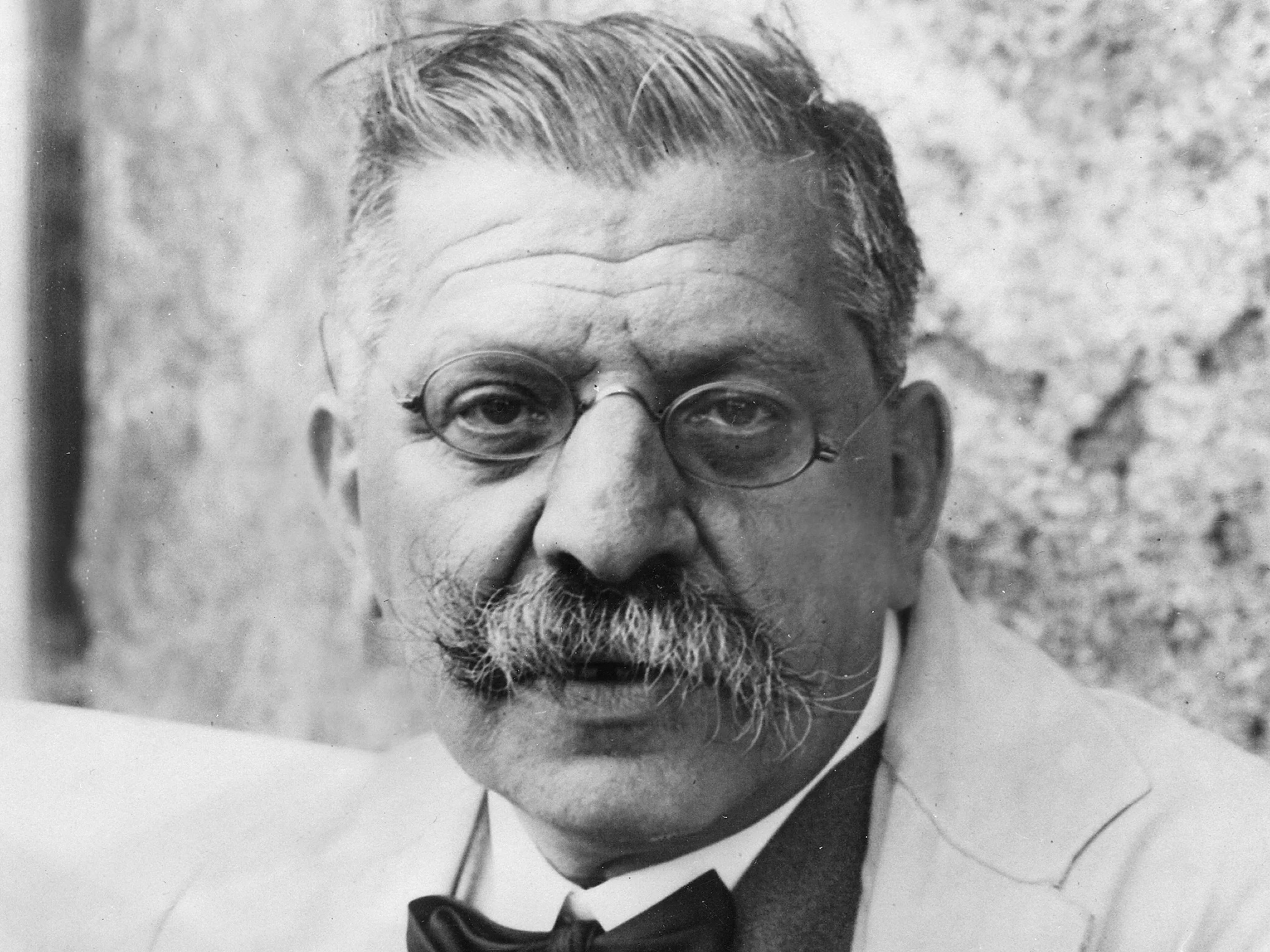
Dr. Magnus Hirschfield
Biography
Dr. Magnus Hirschfeld was a German doctor and sexology expert who gained fame in the late 19th and early 20th centuries for his work surrounding the LGBTQ community. Hirschfeld’s writings and medical work aimed to decriminalize homosexuality and disprove the notion that it was an unnatural phenomenon; he also worked to provide treatment for sexually transmitted diseases, pregnancy, and early gender affirmative care. He was one of the first theorists to conceptualize a wide variety of gender identities, coined the term ‘transvestite’ (then a descriptor and not considered offensive), and developed theories of universal queerness. An early target of Nazism and German conservatism, Hirschfeld’s work remained a cornerstone of modern understanding of gender, sex, and sexuality.
Hirschfeld was born to Jewish parents in Poland in 1868. His father was a well-regarded doctor. Magnus studied medicine and natural sciences, receiving a medical degree in 1892 before spending two years traveling the world on a lecture circuit. On a visit to Chicago, Hirschfeld was compelled by the similarities the city’s gay subculture had to that of Berlin. This discovery would later inform his developing theory on the universality of homosexuality, that homosexuality is a universal and natural biological phenomenon existing across all cultures, time periods, and communities. In 1894 Hirschfeld opened a naturopathic practice in Magdeburg. Seeing the suffering of his patients, Hirschfeld moved his practice to Berlin and published his first pamphlet arguing that homosexuality was naturally occurring. The Scientific-Humanitarian Committee, founded in 1897, is still widely considered one of the first LGBTQ rights organizations in history. Its goal was to use scientific findings to petition the rights of gay, transgender, and gender non-conforming individuals, ultimately decriminalizing the acts.
The impact of World War I on both Hirschfeld and his work was gargantuan. At the start of the conflict, Hirschfeld asserted his patriotism to prove his Germanness, which was often questioned because of his identity as a Jewish homosexual. By 1916, however, Hirschfeld’s ideology turned to pacifism. Horrified by the trauma and suffering caused by the war, and cognizant of the new heights wartime horrors were reaching, Hirschfeld attempted to assert his pride in Germany while calling for an end to the war.
In 1919, Hirschfeld founded the Institut für Sexualwissenschaft, or the Institute of Sexual Research. Opened during the early Weimar period, the Institut aimed to create scientific research on sexual life more broadly. It pioneered research on various queer groups, as well as offered services such as sex counseling, pregnancy care, treatment for sexually transmitted diseases, gynecological examinations, and gender affirmative care. Around this time Hirschfeld met his longtime partner, Karl Giese, who studied alongside him. This period of Hirschfeld’s life was marked by significant scientific work and writings, but Hirschfeld was facing the pushback of a society that was not ready for his findings. German society was by and large opposed to public discussions of sex and sexuality; by the 1920s and with the rise of authoritarianism they were considered immoral and decadent, and queer communities symbolic of the degradation of German society. In 1921 Hirschfeld was beaten and nearly killed by far-right extremists in Munich. This attack was part of a larger escalation in tensions in Germany; Hirschfeld, both openly gay and Jewish and studying sexology, was a prime target. Nationalists disrupted countless lectures and attacked Hirschfeld’s work publicly.
By the late 1920s and early 1930s, Germany was becoming more authoritarian rapidly. Hirschfeld, still a proud German, began to predict that there was no future for queerness in the country and began to look abroad for a new place to settle. On a 1930 world tour Hirschfeld visited a number of countries, including the United States (where he spoke mostly on heterosexual sex), China (where he met another long term partner, Li Shiu Tong), India, Egypt, and Palestine. He briefly considered relocating to the U.S. or to Jerusalem, but was put off by the adoption of Hebrew as an official language and his perception of chauvinism by some Zionists. In the end, Hirschfeld returned home to Germany.
The Institut was lost in 1933. In 1932, Franz von Papen came to power— the Institut remained open, but its members were consistently harassed. In 1933 Hitler became chancellor and, shortly afterward, the Institut was sacked. Nazi German Students’ League members stormed the grounds, shouting ‘burn Hirschfeld’, and began to loot the headquarters. Shortly after, the Sturmabteilung carried out a more systematic attack. Hirschfeld was out of the country for a speaking engagement at the time and would never return to his country. He stayed in France, living with both Giese and Li, but remained close to Berlin in hopes that the political situation would change in his lifetime. It never did. Hirschfeld died at his home in Nice in 1935, aged 67. He left his work to his partners, but between the sacking of the Institut and Giese’s suicide after the Nazi annexation of Austria and the deportation of Giese’s heir to the Lodz Ghetto, the inheritance was lost in the Holocaust.
Hirschfeld’s legacy remains prominent as having informed much of modern day sexology and LGBTQ scientific research. The incessant targeting of Hirschfeld by Nazis was the result of fascist anti-intellectualism; as the Nazis blamed Jews and homosexuals for misguiding German society with decadence and elitism, Hirshfeld’s identities and work left him a prime target. Still, the work he was able to publish made massive strides for queer communities and the decriminalization of homosexuality, and the surviving research is still studied today.
(This biographical statement written by Malena Glover. from these sources: https://encyclopedia.ushmm.org/content/en/article/magnus-hirschfeld-2;
The Einstein of Sex: Dr. Magnus Hirschfield, Visionary of Weimar Republic by Daniel Brook; and
https://www.keshetonline.org/through-science-to-justice-the-story-of-magnus-hirschfeld-a-gay-jewish-trailblazer/)
Biography Date: July 2026
Tags
Jewish (ethnic, Reform, Reconstructionist, Orthodox) | Author/editor | International Human Rights | Berlin | Germany
Citation
“Dr. Magnus Hirschfield | Profile”, LGBTQ Religious Archives Network, accessed October 21, 2026, https://lgbtqreligiousarchives.org/profiles/magnus-hirschfield.
Remembrances
Have a story to share about Magnus Hirschfield? Tell us your experience.
(All entries are reviewed by the LGBT-RAN office before posting.)