Indigo is an afro-indigenous Philadelphia-based organizer and culture worker who founded Queer Ma’idah, a community organization for queer and trans Muslims in the Philadelphia area. They were born in Santiago de Cuba, the 5th out of 7 children. They were always surrounded by their large extended family. They immigrated with their family to the United States when they were six years old in 2006. For several years they lived in Florida in and outside of Miami, Tampa and other rural towns. They moved to the Northeast in 2010 and graduated from high school in Delaware. They then moved to the Philadelphia area in 2019.
Indigo always knew they were queer but they were not always equipped with the language to self-identify. Having been socialized as a young black man, they learned about sexuality in binaries of ‘gay’ or ‘straight’ and they felt they had to identify with either of those labels. It was confusing for them to not fully understand what was happening or have others try to explain their identity for them. They did not fully grapple with gender identity until their best friend came out to them as trans. That was the first time they were able to ground their queerness in something concrete. So they learned more about gender fluid/ gender nonconforming and gender queer identity. Always being an avid reader, Indigo turned to literature and other resources online to find more information and use gender as an analytical lens.
Transitioning into high school, Indigo came more into their queerness and transness through exploring narratives, transforming through new information. They started a Queer Straight Alliance club at their high school and participated in several educational programs centering issues facing young rural queers in their community. Around this time they also started to explore Islam, fasting for Ramadan in solidarity with their Muslim friends. A childhood friend’s mother taught them more about Islam, and after much research, exploration and many conversations they began to practice intentionally.
Indigo attended Temple University, and studied cultural anthropology and global affairs. While at Temple University, Indigo was involved in organizing around labor issues at the university such as supporting striking staff and campaigns to remove Aramark from the dining facilities. They also began participating in the Muslim Students Association (MSA) but did not feel welcome because of their queerness. Although they did form meaningful Muslim connections with a few individuals who were part of the MSA as well as some members of Temple’s Students for Justice in Palestine. While they were unable to find the Muslim community they sought out at Temple, they were able to find community with other queer students organizing with the Queer Student of Color, Temple United Students Against Sweatshops, and a local black feminist writing collective. When the Covid pandemic hit in 2020, they became unhoused when the dorms were shut down. After months of couch surfing, they set up a tent in Center City and lived there with other unhoused folks for several months.
In the beginning of the 2020 uprisings for racial justice against police brutality of Black people, unhoused organizers in Philadelphia collaborated on starting a protest encampment on the Ben Franklin Parkway. The encampments built off of the momentum of racial reckoning, advocated for affordable housing in Philadelphia. Indigo organized with and lived at encampments for their duration and it is from this experience that propelled indigo deeper into organizing in Philadelphia. For years they organized around issues of displacement and gentrification, supporting several initiatives focused on harm reduction, housing justice and mutual aid.
During the encampment, they internalized transness and Islam as politics of resistance and struggle. Many of the people at the encampment were queer, and many were gender expansive or gender nonconforming. Indigo noted that no one cared what pronouns they used, and felt mutual solidarity because members of the encampments were struggling and advocating for each other regardless of gender and sexuality. Indigo noted that individual expression reflected the transientness and systems that necessitated resistance. Indigo saw that the encampment space was not only a space of solidarity but also a site of worldbuilding for the capacity to build new futures.
Their mentor in the encampment, Jen, was also Muslim, and they met other Muslims in this space. At the encampment, they were able to ground their faith in community and brotherhood. That faith leaders of all walks of life could also be on the ground and live out their religious values through struggle. Faith leaders showed up and did hard labor on behalf of the encampment. Indigo also celebrated Eid in the encampment. Celebrating and working alongside other Muslims helped solidify the purpose of Islam as seeking out justice and community. This is also the first space where Indigo felt fully accepted as a queer and Muslim person.
Indigo met other queer and trans Muslims in Philadelphia through mutual friends. The queer and trans Muslim community will use word of mouth and recommendations to make friends and find spaces. Indigo’s friend Dalia, who was one of the first religious queer Muslims they met, helped them find broader community. Dalia brought Indigo to their first communal queer Eid celebration in Germantown. Indigo was also in an informal community on Whatsapp where people would meet sporadically, but this was an intimate community who intentionally sought out space for themselves.
Indigo noticed that older queer folks had more settled and established family lives, but the younger queer and trans Muslims of the community were struggling. So Indigo was motivated by this to start bringing people together and facilitating spaces. In 2021, they would host their friends every Friday during Ramadan. They did this for two years and it was well-received and people would look forward to the gatherings. It was a great space for people to connect, bring and share food, and talk about themselves. It was an intimate space for queer and trans Muslims to share conversation and be in community with one another.
Indigo’s organizing focuses on displacement and its effects, domestically and internationally. As a displaced person, they feel it is important to be in solidarity with people who also face displacement as result of occupation and conflicts, like in Palestine and Sudan. They have supported harm reduction efforts with unhoused populations, and immigrant/refugee support. They worked with some refugees from Afghanistan to stage hotel sites where they were placed. Indigo is currently a member of several organizations such as Philly Palestine Coalition, Queers for Palestine, Philly for Sudan, Philly Black Radical Collective, and Ubuntu Freedom.
With the queer and trans Muslim community in Philadelphia, Indigo had been hosting iftar events with friends for some time. They decided to apply for a grant to support this work and get financial support. They found a grant that funded intentional communities, and their friend proposed a dinner series, but Indigo wanted to expand beyond the people they knew and have a broader impact. They established Queer Ma’idah as a container to showcase the work in the grant application. Creating an online space, it gained traction when people interacted with the graphics on Instagram and contacted the page asking how they could get involved. People in their individual capacities were already trying to build out a larger queer and trans Muslim community in Philadelphia, so in the first year Queer Mai’dah was able to bring these people together. Queer Ma’idah is a community-led collective where members can propose and run their own programs. Much of the programming, especially during Ramadan, occurs organically through member motivation and organization. They have Ramadan programming and have dinners at members’ homes, as well as Eid celebrations. They have also hosted jummah and queer halaqas. Indigo aims to have a multidenominational religious space that can be grounded in radical politics that can be used for ritual space as an open and affirming space.
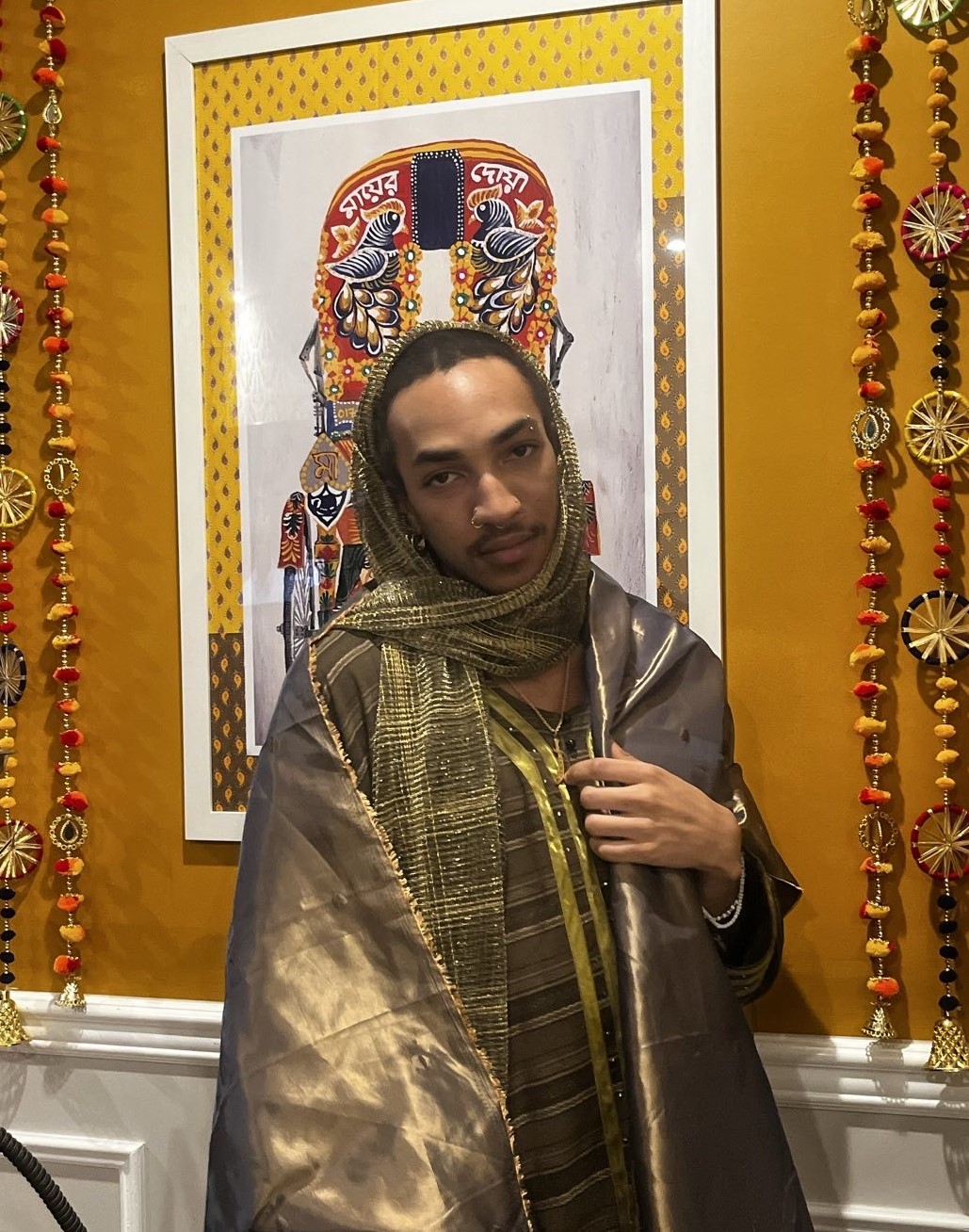
The value of a space like Queer Mai’dah cannot be understated in a city like Philadelphia where Indigo sees how communities and access to resources can be so inequitable. Queer Mai’dah is a space that can save lives, especially in contexts where people do not have a safe environment to be themselves. Queer Mai’dah is part of the larger movement to document and affirm the existence of queer and trans Muslims, especially in a moment of rewriting of history around queer and trans existence.
Indigo also is the curator of a digital archive on Instagram called theindigo.archives where they have established a digital database for visual engagements with queer, black and indigenous history. Indigo releases playlists with academic resources, archival content and cultural analysis on topics such as land and labor struggles, movement history, ethnographic film, liberation theology, and much more.
Indigo is also a herbalist, working with herbs to make teas and tinctures. They also make body butters, hair oils and skincare products. Coming from a displaced upbringing with many of their Cuban family members being undocumented and not having access to healthcare, they witnessed and learned how their family would create healing and preventative remedies through holistic and natural medicine.
For the last year and a half, Indigo has been fundraising for his friend Marcel in Northern Gaza. Indigo launches sporadic campaigns to be able to send funds to help Marcel survive. Recently, Indigo has been organizing queer speed dating events to raise money for Marcel. Indigo also works for the Philadelphia Parks and Recreation department. Indigo is a culture worker, organizer, folklorist and community-building expert, who wears many hats in cultural preservation, healing, infrastructure building and material aid.
(This biographical statement was written by Soaad Elbahwati and was reviewed by Indigo.)
Biography Date: December 2025