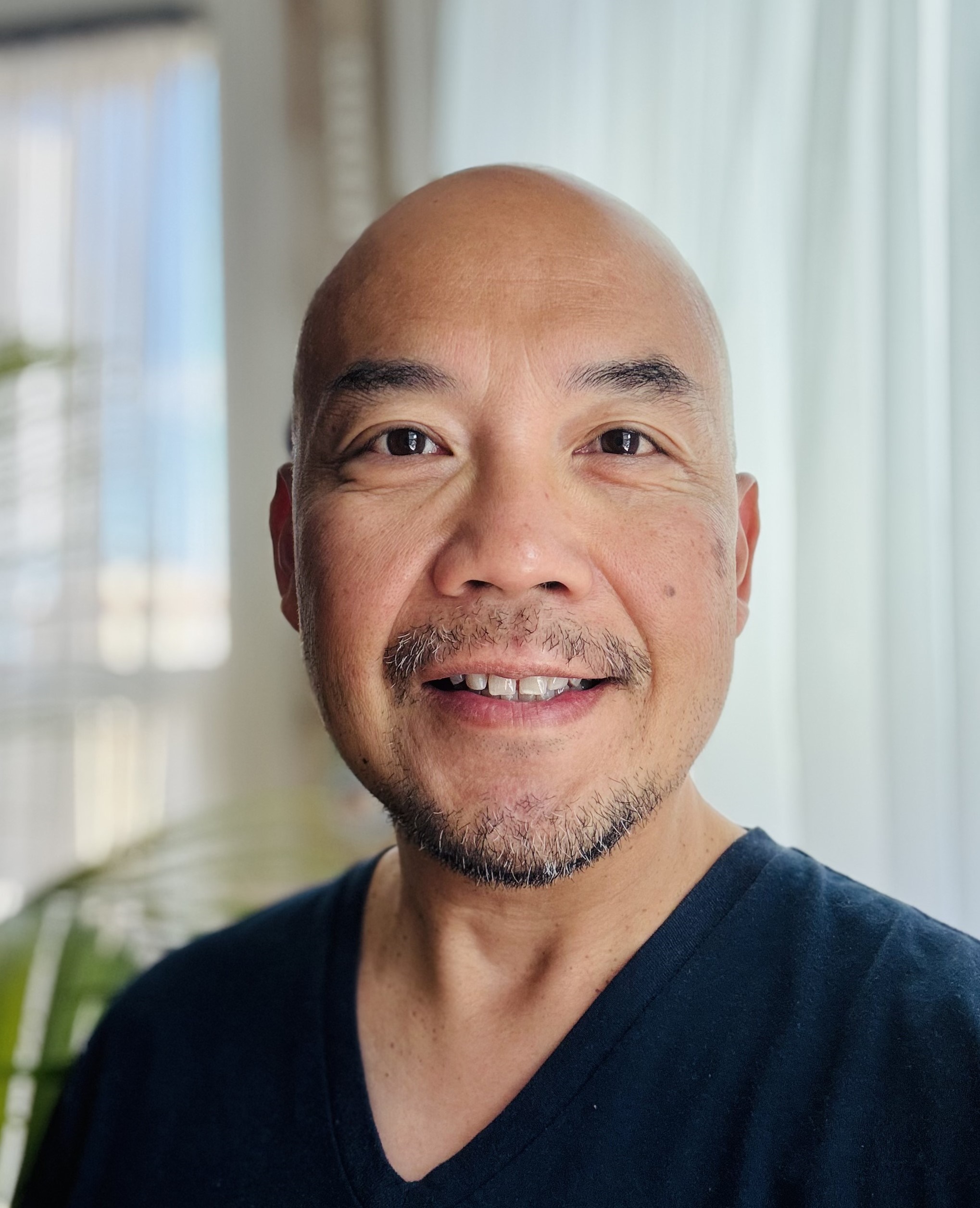
Michael Sepidoza Campos
Biography
Michael Sepidoza Campos teaches high school religion in San Francisco, California and serves as a faculty member at a Catholic university in Manila. He researches at the intersection of Filipino-American diaspora, postcolonial theory, queer theory, and critical pedagogy, with particular focus on theological anthropology. His professional commitments straddle academic research, educational formation, and community practice.
Born in the Philippines, Campos experienced a transnational upbringing that brought him to Guam as a child due to his father's work. His parents' commitment to Catholic education provided Campos with the context to define his Filipino identity while offering foundation to his intellectual formation.
Campos's early interest in religion moved him to explore ordination. In Manila of the late 1980s, one could only study theology in preparation for the priesthood and so, off he went to college seminary. These years were full of eye-opening experiences, allowing him to cross multiple boundaries: class, politics, even diverse expressions of masculinity. As a gay man, Campos could not be "out" in a traditional, Roman Catholic setting. But among others like him, Campos learned new ways of communicating, affirming interests in the arts, music, and scholarship. At seminary, he found key aspects of his life aligned — and deeply celebrated.
Armed with a scholarship, Campos completed his studies at the University of San Diego. Through the encouragement of mentors—particularly theologian, Orlando Espín—he discerned pathways beyond ordination. Espín encouraged him to pursue studies outside the limits of Catholic institutions, to expand his worldview, interrogate assumptions of God and self, and address social concerns. Campos took these questions to Boston where he completed a graduate degree in Theological Studies at Harvard Divinity School.
Boston offered Campos the space to come out. In the mid-1990s, Harvard situated LGBTQ experiences to the forefront of academic study. The classroom was as much a place of inquiry as it was of upheaval. It was both overwhelming and liberating. Access to the faculty at nearby Weston Jesuit grounded Campos's questions, allowing him to return to Catholic theology with a more critical—even loving—appreciation for tradition.
Campos's subsequent work at a large Boston-area Catholic high school unveiled a strong affinity for secondary education. This unexpected turn modified his initial hope to pursue an academic career. Instead, he found himself immersed among young people, finding hope in the questions of those still coming to voice. A brief foray among Benedictine monks further helped Campos align seemingly oppositional aspects of his life—faithful and critical, queer and privileged, diasporic and grounded, teacher and monastic.
Eager to solidify his career as a high school teacher, Campos returned to school. Ironically, this led him back to academia, integrating theology, philosophy, and pedagogy at the Graduate Theological Union in Berkeley in the mid-2000s. To bolster his research, Campos affiliated with the Pacific School of Religion, drawn to its Center for Lesbian and Gay Studies in Religion and Ministry and the Institute for Leadership Development and Study of Pacific and Asian North American Religion (PANA Institute).
At the GTU, Campos examined personhood through the lens of migration, queerness, and faith, exploring how individuals negotiate identity across cultural and theological boundaries. Drawing from the context of Filipino-American diaspora, Campos intuited queer impulses behind the construction of citizenship. Mentored by Boyung Lee, Mayra Rivera, Marion Grau, Martín Manalansán, Naomi Seidman, and Tito Cruz, Campos synthesized his questions into a coherent scholarly framework, positioning queerness as an epistemological lens rather than a pastoral or ethical concern.
Campos identifies foremost as a teacher whose work bridges scholarship and ministry. He seeks to cultivate dialogical environments where students engage identity, ethics, and theological imagination. Being able to question and invite others into the muck of it all constitutes the heart of his work. Tedious at times, this is also the most expansive and queerest of spaces for transformative teaching.
(This biographical statement was written by Elizabeth Herrick from an interview with Michael Sepidoza Campos on February 6, 2026 and was edited by MS Campos.)
Biography Date: February 2026
Tags
Catholic (Roman) | Philippines | Theology | Graduate Theological Union (Berkeley, CA) | Pacific School of Religion (Berkeley, CA) | International Human Rights | San Francisco | California
Citation
“Michael Sepidoza Campos | Profile”, LGBTQ Religious Archives Network, accessed October 13, 2026, https://lgbtqreligiousarchives.org/profiles/michael-sepidoza-campos.
Remembrances
Have a story to share about Michael Sepidoza Campos? Tell us your experience.
(All entries are reviewed by the LGBT-RAN office before posting.)